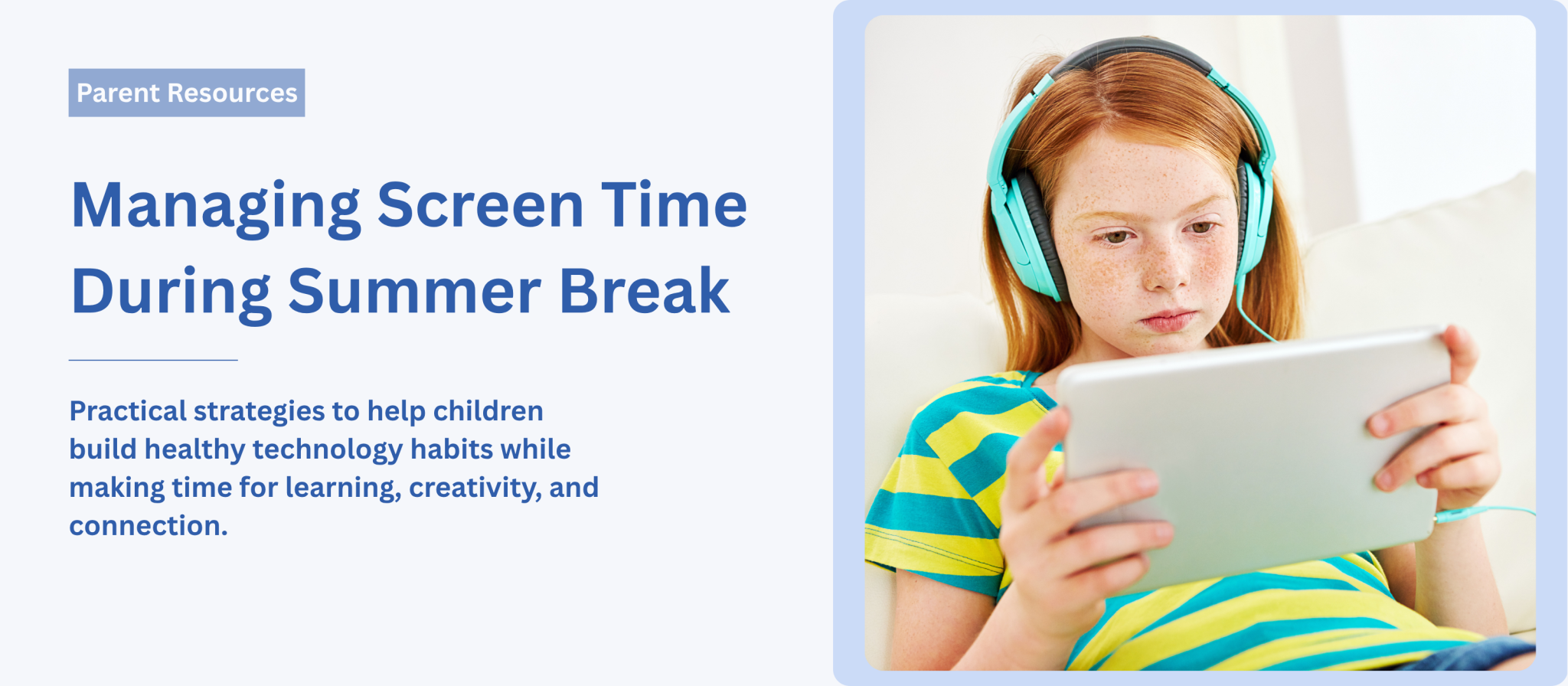
Summer offers children more free time to relax, explore new interests, and recharge—but it can also mean more time spent on screens. Without the structure of school and extracurricular activities, many kids naturally gravitate toward texting friends, gaming, scrolling social media on platforms like TikTok, Instagram, or Snapchat, or watching videos on YouTube. With a little planning and balance, families can help children develop healthy technology habits while making room for learning, creativity, and real-world experiences.
- Not all screen time is equal. A great benefit of online access is that kids can use the lazy days of summer to learn new skills and explore unique interests. Is astronomy your child’s passion? How about painting, graphic design, or woodworking? Does your budding athlete want to bend it like Beckham or shoot a three-pointer like Caitlin Clark? Whatever their interests, there’s an age-appropriate tutorial one click away. When children have more free time, social media often becomes the default. Encouraging purposeful, interest-based screen time can help them learn new skills while still enjoying technology.
- Use technology purchases as teaching moments. Kids are often drawn to the newest, shiniest tool in the tech toy box, but that doesn’t mean they have to have it. With new devices, apps, and software constantly being released, trying to keep up can be both expensive and exhausting. Use the “can I have” opportunities to teach values such as moderation (“You already have X, you don’t need Y”), patience (“We can talk about it if you still want it in a few weeks”), and work ethic (“Let’s figure out how you can earn the money to buy it yourself”).
- Think goal first, format second. To fill idle time or stave off boredom, remember that the screen is only one option. Work with your kids to create a menu of alternative options to fill the void. Divide the menu into short, medium, and lengthy activities, and include items they can do by themselves, with friends, or with siblings. Figure out what materials are required (crayons and paper, bats and balls, game boards and decks of cards, etc.) and stock up accordingly.
- Divide free time into chunks. Allow for some screen time, but aim for a healthy balance with off-screen activities. Encourage outdoor play, in-person time with friends, family conversations, and shared activities that help children stay active, connected, and engaged throughout the day.
- Consider listening. Audiobooks, podcasts, and recorded read-alouds are valuable tools for providing a welcome break from staring at screens.
- Don’t forget handwriting and other old-school options. Rather than use digital media for emailing grandma, texting friends, keeping a journal, reading a book, encourage your kids to use pen and paper to write letters and make journal entries, and use a phone to actually speak to a friend. Plan a library outing to pick up hardcover copies of their favorite books.
- Stay on top of academic skills. Learning fractions by cooking a recipe or exploring nature and writing about it can get children off their screens while providing skill-building opportunities and preventing “summer slide.”
A meaningful summer doesn’t have to be screen-free. By helping children balance technology with creativity, movement, reading, social connections, and real-world experiences, families can turn the summer months into an opportunity for growth. A little planning and intentionality can go a long way toward building healthy habits that last well beyond the start of the new school year.
RELATED RESOURCES FOR FAMILIES