
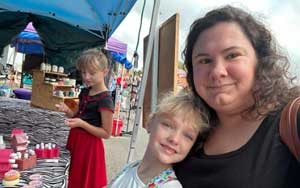
 My daughter, Rosie, is nine years old, and I currently homeschool her.
While many families hesitate to share their homeschooling experiences, I’m a teacher by trade and committed to supporting families like ours. Having a child with learning challenges has sharpened my focus on accessible learning.
Last winter, Rosie began showing signs of ADHD: disorganization, difficulty starting tasks, and missed deadlines. Her dyslexia made reading a struggle, and her confidence began to slip.
I tried to set up an IEP or 504 plan through the public school system, but holiday delays and staff turnovers stalled the process. Eventually, I made the tough decision to reduce my teaching hours, and with the help of my mom, a retired teacher, Rosie and I made the transition to homeschooling.
Now, each morning, my daughter and I learn together. I’ve tailored her education to fit her needs, focusing not just on academics but also on building habits and self-esteem. Homeschooling has allowed us to prioritize her mental health and learning style .
Building the Right Learning Environment
Rosie and I share a lot—we both have ADHD and dyslexia. I wasn’t diagnosed with ADHD until high school, and didn’t realize I had dyslexia until college. Looking back, the signs were always there, but I lacked the support to understand them.
With Rosie, I recognized the signs earlier. She was curious and energetic as a toddler. By kindergarten, she had trouble with reading and multi-step instructions. Even simple routines like tying shoes were a challenge. A full evaluation clarified things: Rosie isn’t built for rigid routines, but they were often overlooked or misunderstood.
Our curriculum is hands-on and fully customized. For example, when we study history, Rosie brings the era to life through art—charcoal one day, watercolor the next. This helps her connect emotionally and intellectually with what she’s learning.
Making it Work on a Single-Mom Budget
Homeschooling can be expensive, but many of our best tools are free or low-cost, like library audiobooks, printable math templates, and flexible curricula that support interest-led learning.
After some trial and error, I discovered that online marketplaces like Temu offer affordable supplies. I buy art materials, notebooks, and tools that meet Rosie’s sensory needs and help me plan creatively. For example, Temu sells pre-printed grammar posters—10 for just $2, which saves prep time and adds structure.
ChatGPT has also been a huge help. I use it to rewrite math problems inspired by Rosie’s 4-H animals or generate reading questions based on her favorite books. It’s helped make her lessons more engaging and relatable.
Navigating Big Assignments
One ongoing challenge is helping Rosie manage long-term assignments. She gets overwhelmed easily and struggles with pacing. We break projects into steps, use visual checklists, and celebrate milestones to keep her motivated.
Math has also been a hurdle. Dyslexia affects her number placement, and multi-digit problems can be especially tricky. I use simple templates to help her line up numbers correctly. These guides don’t solve the problems, but they offer enough structure for her to focus on the concepts.
After some searching, we found the Harry Potter series, which has captured Rosie’s imagination. She listens to the audiobooks while reading along in print, making it easier to follow. She’s now halfway through book four and has read five chapter books in three months—something that once felt impossible. She’s even started writing fanfiction!
Beyond the Classroom
One of the challenges of homeschooling is switching between being a parent and being a teacher. I’ve had to learn when to guide and when to just be Mom.
Rosie and I come from a long line of jewelry makers—a tradition passed down from my grandmother, to my mother, and now to us. I introduced her to jewelry making early on, but her interest didn’t stick until she connected with a local resident, who helped spark her passion.
Now, Rosie and I represent two generations of “Four Generation Crafters,” a small business I started to honor our Eastern Band Cherokee heritage. Rosie even has her own line of colorful bracelets, using larger beads that suit her style and motor ability. We attend craft fairs together, which has opened up another layer of learning. Using beads and other supplies from Temu, Rosie prices her handmade bracelets and earrings at $3 each or 2 for $5, making her art accessible to everyone.
Homeschooling wasn’t our original plan, but it’s been the right choice. Rosie is gaining confidence, and I get to support her every step of the way. If you’re a parent wondering whether you can do this too, know that it’s not always easy. But with the right tools and a little creativity, it’s absolutely possible.