
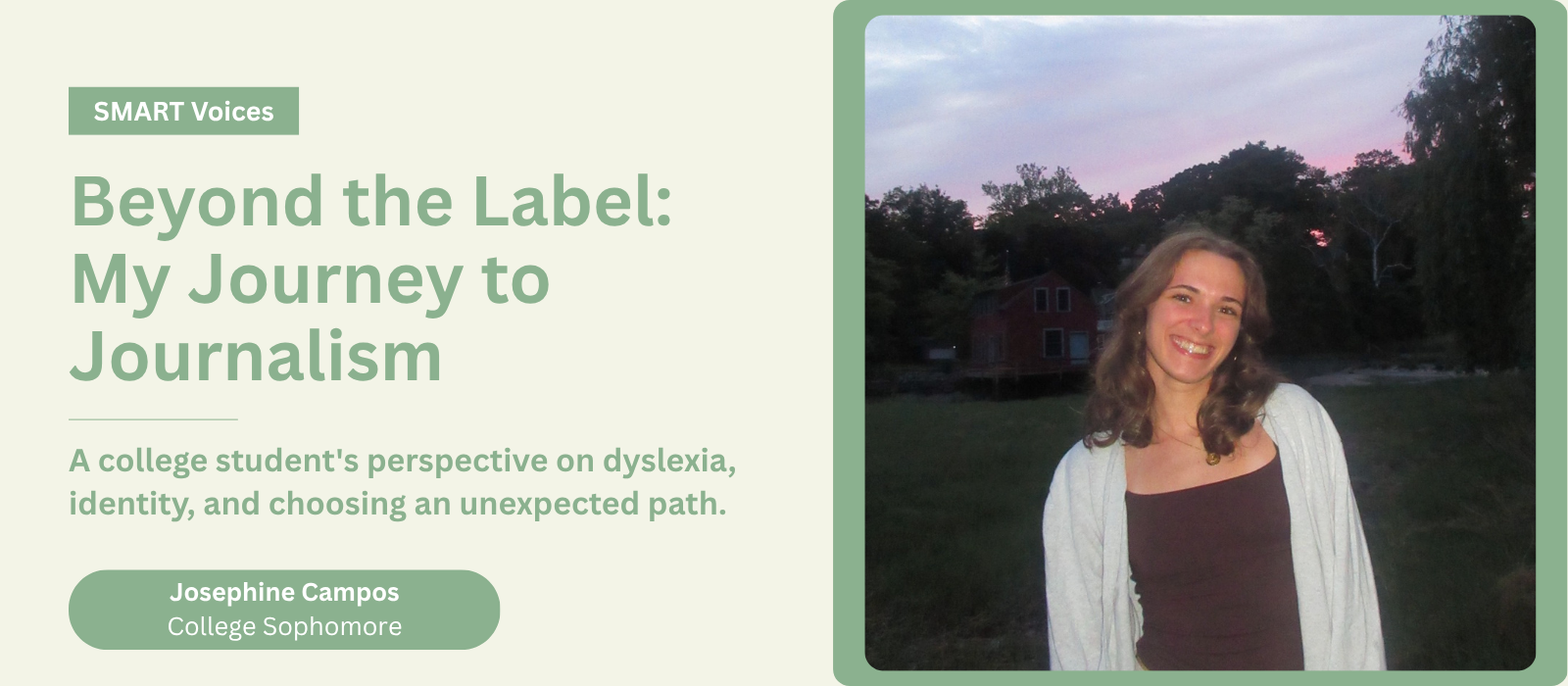
Oftentimes I find myself forgetting that I am, in fact, dyslexic. I don’t fit the typical profile of what dyslexia is perceived to be, and I don’t find myself outwardly struggling with reading and writing. Instead, I’ve gravitated towards all forms of media from a very young age, developing a passion that has remained constant throughout my life. Reading books within a two-day span, writing in my free time, and allowing that love to continue growing have always come naturally to me. However, despite my forgetfulness, individuals around me seem to hone in on that aspect of me, doubting my ability to follow certain paths and careers, summing me up as simply a person with learning differences.
This past fall, I entered college as a declared psychology major while simultaneously writing in my free time after joining the University of Vermont’s chapter of HerCampus, an online global publication platform dedicated to college women. I joined the chapter writing about a range of topics but quickly focused on culture. From the Olympics to the Oscars, I grew up wanting to write for a culture magazine, so covering those topics felt like fulfilling a long-held dream.
Following the first semester of college, I realized that my love for writing and all things related to literature far outweighed my interest in psychology. I ultimately decided to change my major to public communications, concentrating on journalism at the beginning of my second semester, choosing to follow my passion over what I thought was appropriate and acceptable as a career. The journalism field is notorious for being extremely competitive, especially today, and those around me said as much. However, it wasn’t just the competitiveness that concerned them but also my dyslexia, which made them question my ability to be successful within a field that I was deemed incapable of surviving in. At first, it was disheartening to hear these concerns, but I also didn’t—and still don’t—care.
Ignoring those concerns, I decided to switch from a social science major to one in the humanities, and as someone with learning differences, this was a change no one around me saw coming. While I did write in my free time and published my work frequently, writing as a hobby is totally different from pursuing it as a career.
Bringing up the idea of switching my major to my friends was often met with questions and doubts, many of them mentioning dyslexia and the continued competitiveness of the field. The same people who supported me when writing was a simple hobby suddenly became doubtful when it turned into a possible career path. So, when I finally made the decision to officially change my major to public communications, I didn’t tell anyone, not wanting to second-guess myself or having doubts start piling into my mind. I didn’t need the devil on my shoulder reminding me of the learning difference that I’ve lived with for seven years.
Keeping it quiet from my friends was irritating, especially when this was a change I’d been excited about since the end of my first semester. Asking for directions to the College of Agriculture and Life Sciences building and having to lie to my roommate when she became suspicious of why I was going there instead of the College of Arts and Sciences was brutal but, in my mind, necessary. I waited until my account stated “Public Communications” under my major, making the switch official and final, before I revealed the truth.
In the beginning, even with unwavering support from my family, I couldn’t ignore the concern I was witnessing. Many of my friends were either supportive or completely unbothered, but the reactions of a few individuals overshadowed the encouragement I received from everyone else. Their concern never outweighed the support, but for a while, the volume of it did.

Journalism and dyslexia are an unconventional pair, considering how the overarching view of dyslexia is that it impacts comprehension and strength within reading and writing. Despite this, I am more than my learning difference, and I do not regret any choice I made to switch career paths. I have consciously chosen to follow this career path time and time again. I would rather choose a future I continuously love than one where my love and passion are finite and will one day disappear. Being able to write gives me the ability to open doors for those who consume my work, letting them witness and attempt to comprehend things that they might not otherwise get the chance to experience. It’s rewarding to be able to share my work with the world and offer a window into my own perspectives of the world.
Dyslexia should never limit what a person can achieve—not through the diagnosis, the challenges it presents, its impact, or the perceptions and misconceptions of others. If anything, every individual has strengths and weaknesses, regardless of whether they have a learning difference. Even within the same diagnosis, every individual is unique and shouldn’t be compared to the person next to them. Career paths aren’t truly limited. We may think they are, as that is all we have been taught to believe, but in reality it’s not your ability that is limiting, but the perception of those around you. Following passion over perceived obligation is rewarding, breaking stereotypes and finding a career outside of the stereotype and outside of the diagnosis. Learning differences are just one part of who you are and who you can become.

About the Author
Josephine Campos is a sophomore at the University of Vermont. She is currently studying public communications with a concentration in journalism and community media. She enjoys reading, writing, arts and crafts and being outdoors.
Related Resources for Families
- Programs & Events
- Webinar Recordings
- Getting Help: Dyslexia Resources
- Subscribe to the Smart Kids Newsletter
- Recommended Reading: Parenting Dyslexia