
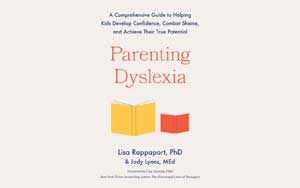
 When Lisa Rappaport was in high school, she became so frustrated by her dyslexia that she was on the verge of dropping out. Not only did Rappaport turn things around, but she went on to earn an undergraduate degree from the University of Pennsylvania, followed by a Ph.D from Fordham University. Today, Rappaport is a licensed clinical psychologist who specializes in treating children and adults with dyslexia and ADHD.
SK: Why did you want to write Parenting Dyslexia?
LR: I wrote the book because I realized I have a unique perspective because I am dyslexic, I have a child with learning differences, and I am a child psychologist who works with kids with learning disorders. I relate to it on three different levels.
SK: You write, “Shame is hands down the most insidious problem compounding dyslexia.” Do you think it’s better for kids now?
LR: Sometimes it’s so embarrassing that kids would rather be seen as lazy or cut class and get in trouble than say, “I just don’t understand this.” That brings shame, especially if they have parents or teachers who say, “Can you try harder?” I think it’s better now because there’s more awareness, people are a little kinder, and there are accommodations that didn’t exist when I was growing up. Also, there are better tools—audiobooks, AI, books on tape, and websites that can help kids. My mother had to read to me.
SK: What can parents do to lessen the shame?
LR: They should always be honest about their vulnerabilities. If your child thinks you’re perfect or didn’t suffer, they won’t come to you and say, “This is hard for me.” Kids want a role model who has failed, been embarrassed, and come back from that. Every child should fail in middle school because then they’ll see that you can survive and pivot from failure.
Also, parents can help them learn to laugh at mistakes and themselves. If a child is reading out loud in class and makes a mistake, if they can say, “I’m so dyslexic,” rather than being humiliated, it makes it easier.
SK: What are some mistakes parents of children with dyslexia make?
LR: Frustration is a big one. If your child can read a word and doesn’t reverse it three times but then reverses it on the next page, it’s not because they got lazy, tired, or didn’t try—it’s because the wiring got messed up. Parents don’t understand that these skills have to be overlearned until they become automatic.
Also, there shouldn’t be competition within a family. Family members need to lift and support each other. My sister is two years younger, and she tutored me. We couldn’t have had that dynamic if there had been competition between us.
SK: Can you recap how to talk to your child about their test results and diagnosis?
LR: It helps a child if they know there’s a word for what they have and it’s not “stupid” or “lazy.” No matter how old they are, they should understand their diagnosis and that things are going to be harder for them, but they are still expected to learn. It’s also important that children understand their strengths and weaknesses and that they can use their strengths to develop their weaknesses.
SK: Why is it important to enhance skills at home in addition to using outside tutoring?
LR: There are certain things parents can do to enhance interventions that are taking place in school or even with a tutor. For young children there are language games that parents can play (they are discussed in my book.) For all children, helping them to develop organizational skills and time management skills is something parents can work on in addition to outside interventions and support.
Every child should also be taught organizational skills when they are young. It takes 15 minutes to organize them when they walk in the door, and it becomes automatic pretty quickly. It can start when they are little and you organize their room and toys, so they are already organized by middle school with their desk, schoolwork, and room.
Even if you have an executive function tutor, you should still work on organization at home because the tutor is not there on weekends. It makes it more seamless in high school if it’s done in the house and not farmed out to somebody they are answering to once a week or once a day, rather than it just being part of family life.
SK: One chapter in the book is titled “Practices to Bolster Self-Esteem.” Can you offer tips?
LR: The key is to let your child know it won’t always be this way. One thing kids don’t realize, and maybe parents too, is that it’s going to get better as long as they do the work. Make sure your child learns to read; you don’t want them to rely on computers and AI to read to them or do math for them. I always say to my daughter, “It won’t always be this hard; it will get easier.” We are living what I talk about in the book.
It is also important for self-esteem to find something your child is good at and plug them into that because going to school every day and feeling horrible about yourself is terrible. And the child may not find it on their own. There may be a twinkle of it—maybe they like to draw or bake—whatever it is. Take that as their gift and grow it.
SK: How else should the parents’ role change from elementary to middle to high school?
LR: When kids are young, it’s important to be involved because you don’t want them to miss the foundations. My mom understood my learning style better than my teachers. As they shift into middle school, start to scaffold more than help with homework, and gradually help them become independent because you don’t want to create dependencies through high school. You have to understand that they are capable, smart, and expected to get to a point where they are functioning and independent.
SK: What do you mean when you write, “Trying to find their intrinsic motivation should be a core mission?”
LR: Motivate your child to do the work and get through high school for themselves and not for the grade. It’s hard to work for just a grade when you are not getting the grades you want. If they hate school, they hate school, but try to find a way to motivate them for the bigger picture. I got through school because I knew I wanted to go to college, and I wanted to have a career as a psychologist. My intrinsic motivation got me up in the morning and to school on time because I was looking at something beyond those last two years.
Parenting Dyslexia: A Comprehensive Guide to Helping Kids Develop Confidence, Combat Shame, and Achieve Their True Potential, by Lisa Rappaport, Ph.D and Jody Lyons, M.Ed (Balance Books, a division of Hachette Book Group, 2025) is available at Amazon and other bookstores. Michele Turk is a Connecticut-based writer, editor, and tutor. She is the author of What Makes Him Tic? A Memoir of Parenting a Child with Tourette Syndrome (Woodhall Press, 2024).